Water damage and wet area repairs in Sydney
Water damage in a house is two jobs that people usually think are one. There is making good what the water ruined, and there is lining a bathroom or laundry properly so it does not happen from the inside. We do both, and the honest starting point on either is that plasterboard which has been substantially wet is generally replaced rather than dried out and painted. That is the board manufacturer's own position, not a way of selling you a bigger job. What we will not do is re-line anything while the source is still running or the cavity is still wet, because that is how the same repair gets paid for twice.
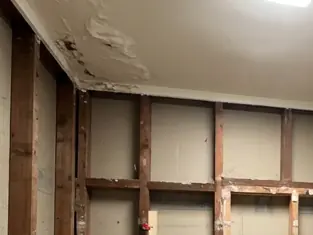
Storm, roof leak and burst pipe damage
Sydney gets this in bursts rather than steadily, and after a serious east coast low the phone does not stop. Ceilings stained or bellied from roof water, walls damaged by a burst hose or an overflowing washing machine, and upper floor leaks that arrive in the ceiling below. The work is straightforward once the water has stopped and the cavity is dry.
- Affected board removed rather than dried and painted over
- Frame and insulation checked and left to dry before anything is re-lined
- Ceilings replaced where water has been through them, which is most of the time
- A written description of what we found, which is usually what an insurer asks for
- Sequenced after the roofer or plumber, never around them
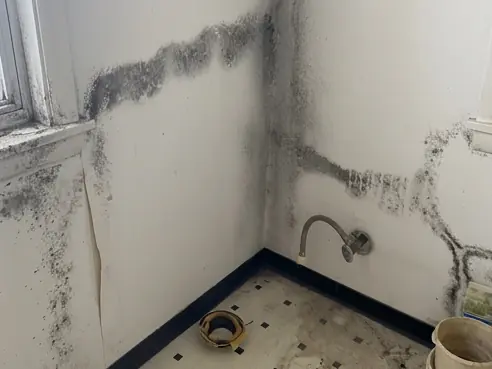
Bathroom, ensuite and laundry re-lining
The other half: lining a wet area properly so the water stays where it belongs. Usually part of a bathroom renovation or a re-line after a membrane has failed, and always sequenced with the waterproofer and the tiler rather than dropped in between them.
- Water resistant board with core and liner both treated, not a surface coating
- Every cut edge sealed, including the bottom edge over a preformed shower base
- Water resistant jointing compound in two coats, with all fastener heads covered
- Fully fastener fixed with joints on stud, because adhesive is prohibited under tiles
- Control joints at the tighter spacing a tiled wall needs, not the standard one
- Mould resistant board and glass mat tape where a room genuinely stays damp
What goes wrong with water damage, and what stops it
Nearly every failed water damage repair in Sydney comes down to one of two impatiences: starting before the cavity was dry, or lining a wet area with the wrong materials because they were on the truck. Both look completely fine for the first year.
Re-lined before the cavity had dried
New board over a frame and insulation that are still wet traps the moisture rather than fixing anything, and it comes back as staining, mould or a soft patch months later. A moisture meter is the only way to know when it is safe to start, and the honest answer is often that the room has to sit with air movers for a while first. We would rather tell you to wait than book the job in for Thursday because that suits us.
Standard board used in a wet area
A bathroom, ensuite, laundry or toilet needs water resistant board where the Code requires it, and that board has both its core and its liner treated rather than just a coating on the face. Kitchens are specifically not wet areas under that definition, which is a distinction worth knowing. Standard board behind a shower will do its job right up until it does not, and by then the tiles are on it.
Cut edges left raw
Cutting a sheet of water resistant board creates an untreated gypsum edge that will wick moisture straight into the sheet, which is why every cut edge that could see water has to be sealed. The one that gets missed most is the bottom edge sitting over a preformed shower base, because nobody sees it once the tiles are on and it is exactly where the water goes.
Adhesive used on a wall that is going to be tiled
Stud adhesive is prohibited on tiled wet area systems, and the manufacturer states it twice in capitals. Those walls are entirely fastener fixed with every butt joint landing on a stud, and the fixing centres are much tighter than a normal wall: 200mm or 100mm depending on the weight of the tile, against 400mm elsewhere. A tiled wall carries a load an ordinary wall never sees, and building it like an ordinary wall is how tiles come off in sheets.
The shower base installed after the wall linings
A preformed shower base goes in before the walls are lined, not after. Get that order wrong and the junction between the base and the wall cannot be detailed the way it needs to be, which puts a permanent weakness at the lowest and wettest point in the room. It is a sequencing problem rather than a workmanship one, which is why it needs sorting at the planning stage.
Mould with no leak behind it at all
Persistent mould in a bathroom, or in a shaded south facing room, is often condensation and an exhaust fan that is not doing its job rather than water getting in. Re-lining that room fixes nothing. Where we find it we will say so, and mould resistant board and a glass mat tape are worth specifying in a room that genuinely stays damp, but the ventilation is the actual answer and it belongs to somebody else.
Three things that decide whether the repair lasts
The source gets fixed first, by whoever owns it
A roof leak, a failed flashing, a burst flexible hose under a vanity, a shower membrane that has given up, or a neighbour's bathroom in the flat above. Until that is dealt with by the roofer, the plumber or the waterproofer, anything we do is temporary. We will tell you what we can see about where the water is coming from, and we will not re-line around a live leak.
We measure the moisture rather than guessing at it
A wall can feel dry to the hand and still hold enough moisture in the frame and the insulation to ruin new board. A meter answers that, and where the water has travelled behind the lining, tracing it properly matters more than opening the wall in the first place people expect. This is the step that gets skipped when somebody wants the job done this week, and it is the step that decides whether it holds.
We line wet areas, we do not waterproof them
Three trades touch a bathroom and only one of them is us. The waterproofer applies the membrane, we line the walls in the correct board with water resistant compounds and every cut edge sealed, and the tiler tiles. Waterproofing is separately regulated in NSW and it is not our licence to hold. Waterproofing is also the single largest category of serious defect in NSW apartment buildings, at 42% by the Building Commission's own research, which is a good argument for everybody staying in their lane.
Get a free quote
Send photographs of the damage and, if you can, one of where you think the water is coming from. Tell us whether the leak has been fixed yet, because that changes what we can do and when. If this is an insurance matter, say so in the same message and we will make sure what we write down is useful to your insurer. Quotes are free, and there is no travel charge to any suburb we work in.
Brands we supply and install
Plasterboard, cornice and compounds from the major Australian manufacturers, delivered to your job and included in the price.
Service available across every Sydney region
Central and Inner Sydney
Sydney CBD, Pyrmont, Surry Hills, Marrickville, Burwood, Strathfield and Sydney Olympic Park
The Eastern Suburbs
Bondi, Double Bay and Randwick
North Shore and Northern Sydney
North Sydney, Mosman, Manly, Lane Cove, Chatswood, Ku-ring-gai, Hornsby, Macquarie Park, Ryde and Castle Hill
Western Sydney
Parramatta, Blacktown, Merrylands, Fairfield, Liverpool, Bankstown and Penrith
South West and Macarthur
Austral, Leppington, Oran Park, Camden and Campbelltown
Southern Sydney and St George
Cronulla, Miranda, Sutherland and Hurstville
Frequently asked questions
Does water damaged plasterboard have to be replaced?
If it has been substantially wet, generally yes, and that is the board manufacturer's own recommendation rather than ours. A burst pipe, a flood or water sitting in a ceiling is the situation they name. Where it has been lightly marked, has dried without losing strength, has no mould and has not sagged or gone soft, a repair can be the right call. The honest way to tell the difference is to press it and to measure it, not to look at it.
Is plasterboard ruined if it gets wet?
Not necessarily, and the amount matters more than the fact. A small amount of moisture that dries quickly often leaves nothing but a stain, which is a painting problem. Board that has been saturated loses its strength permanently, because the gypsum core breaks down and does not recover when it dries. If a sheet feels soft, crumbles at an edge, has visibly sagged or has a tide mark that keeps coming back through paint, it is finished.
How can I tell if the water damage is permanent?
Four signs are worth checking. The board feels soft or spongy rather than firm. It has bowed or sagged out of plane. The paper liner has lifted, bubbled or torn away from the core. Or the stain keeps coming back through fresh paint, which means the moisture is still there. Any of those means replacement rather than repair. A single dry, firm stain with none of the above is usually just a sealing and painting job.
Will mould grow behind the wall if it got wet?
It can, and it is one of the main reasons for opening a wall rather than drying it from the outside. Mould needs moisture and something to feed on, and the paper liner on plasterboard plus dust in a cavity is enough. If there is a musty smell without a visible stain, that is worth taking seriously. Where we find mould we will tell you and stop, because remediation is not plastering work and pretending otherwise helps nobody.
What does water damage behind the wall look like?
Usually it announces itself before you see it: a musty smell, paint bubbling or flaking in a patch, a tide mark that reappears after painting, skirting or architrave lifting away, or the wall feeling cooler and softer in one area. In a ceiling it is a stain that spreads outward from a point and a slow sag. By the time it is visible from the room, what is behind it is normally worse.
Do you do the waterproofing as well?
No, and it is worth being clear about it. Waterproofing is a separately regulated activity in NSW and we do not hold that licence. On a bathroom there are three trades: the waterproofer puts the membrane in, we line the walls in the right board with the right compounds and every cut edge sealed, and the tiler tiles. We work in with the other two and we will tell you plainly what is ours and what is not.
How long do I have to wait before you can re-line?
Until the cavity is dry, which is measured rather than guessed. The frame, the insulation and anything behind the lining all hold water long after the surface feels dry to the hand, and how long that takes depends on how much water there was, how much air is moving and the time of year. Sometimes it is days. What we will not do is line over it early to suit a schedule, because that traps the moisture and you pay for the job twice.
Will my insurance cover it?
It depends on the cause, and that is the distinction insurers draw. A sudden event, a storm, a burst pipe, a failed hose, is usually the kind of thing a policy contemplates. Gradual seepage from a failed membrane over years often is not. We are not the people to advise you on your policy, but working out where the water came from is part of the job anyway, and a written description of what we found is generally what your insurer will ask you for.
Ready to get started?
Get a fast, free quote, or call now and speak to someone who can help.