Cornice installation and repairs in Sydney
Cornice is the run where your wall meets your ceiling, and most of the decisions about it get made later than they should be. The choice between a cornice and a square set junction is the obvious one, and almost nobody is told that it reaches back into how the ceiling was fastened, so it is not really a decision you can leave until the end. Beyond that, cornice is a job of one long simple run and a handful of corners, and every failure starts at the corners. We install it, we repair it, and we will tell you which of those you actually need.
New cornice, and choosing the profile
For a new home or a renovation the profile is a design decision with a practical side. Standard cove comes in three sizes and the right one depends on the room and the ceiling height rather than on taste alone, because an undersized cove in a high room looks like an oversight. Contemporary profiles and shadowline details are the middle ground between cove and full square set.
- Cove cornice in 55mm, 75mm and 90mm, scaled to the room and the ceiling height
- Contemporary and stepped profiles where cove is too traditional for the house
- Shadowline and negative details as the alternative to a full square set
- Square set where the frame and the fastening will support it
- The junction fastening confirmed before the ceiling is sheeted, not after
Cornice repair, reinstatement and square set conversion
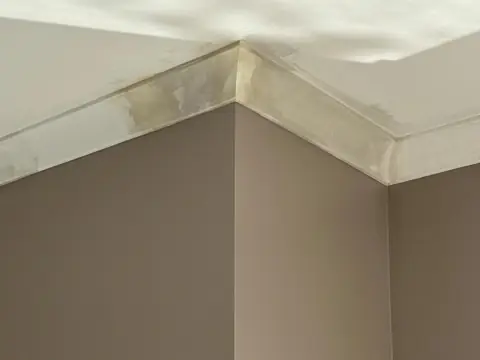
The repair half. Cornice damaged by movement, water, impact or a ladder, cornice destroyed by a ceiling repair, and runs left stopping in mid air after a wall came out. Plus the conversion people ask for most: taking the cornice off for a square set finish, which is a bigger job than it sounds.
- Loose sections re-bedded and mitres re-cut and re-detailed
- Replacement lengths spliced in rather than a whole room replaced
- Cornice reinstated after ceiling repair or replacement
- Runs made good where a wall has been removed
- Square set conversion, which is re-sheeting and re-detailing rather than a swap
- Honest advice where the cornice is reporting movement rather than failing
Why cornice fails, and what stops it
Cornice sits at the junction of two things that move independently, held on by an adhesive, in a room where every corner is a joint. When it goes wrong it is almost always one of these six, and only two of them are really about the cornice.
Stuck up with jointing compound
Cornice cement is a distinct product formulated to grab and hold a gypsum moulding against gravity while it sets. Jointing compound is formulated to fill and finish a joint, and it is usually already mixed, which is exactly why it gets used. The substrate matters too: plasterboard takes cornice cement, but fibre cement, render, plaster glass and any highly absorbent surface need a masonry adhesive instead. Using the wrong one is how cornice ends up on the floor.
Mitres that open up in the first summer
The mitres are the whole job. The correct method is to cut the ends square, butter them with cornice cement and butt them together accurately, fill the mitres with a detailing tool, and then come back with a second coat to the mitres once the cement will hold the cornice unaided. That second pass is the one that gets skipped when a room is being finished in a hurry, and skipping it is why corners open.
Cornice pulling away from the wall
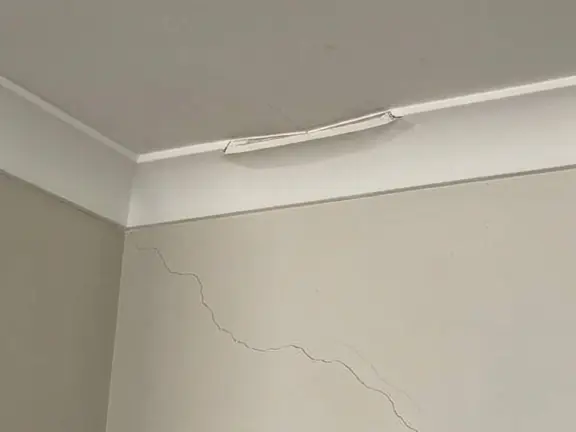
This is a movement report rather than a cornice failure. Cornice separating from the wall is a listed diagnostic of differential footing movement in Western Sydney building inspections, alongside diagonal cracking from window and door corners, and on reactive clay the seasonal ground movement is measured in tens of millimetres. Re-bedding it without understanding why it moved just resets the clock, so the first conversation is about the crack rather than the cornice.
A cornice run straight across a control joint
Where a wall or ceiling has a control joint, it is there because that is where the building is expected to move. A rigid length of cornice bedded straight across it bridges the joint and cracks, usually within a year, in a line that is impossible to fill permanently. The joint has to be carried through the cornice rather than covered by it.
Cornice telegraphing a junction that is not straight
Cornice covers a junction, and it will faithfully report every deviation in the wall or ceiling it is following. A run that dips and rises across a room is usually not a cornice problem at all, it is the frame or the sheeting underneath it, and no amount of care with the cornice itself will straighten it. Where that is what we find, we will say so before we start rather than after.
An original profile replaced with the nearest cove
In a Victorian or Federation home the cornice is often a profile that has not been manufactured for decades. Fitting the closest current cove leaves a visible mismatch in the same room, which is worse than the damage was. Matching properly means measuring the existing section and reproducing it, and it is worth knowing that Gyprock's ornamental range is not even sold in New South Wales, so this is not something anybody can solve at a trade counter.
Three things worth knowing before the cornice goes up
Cornice or square set is decided before your ceiling is fixed
Sheet ends are fastened at 300mm maximum centres where a cornice is going on, and at 150mm where the junction will be square set. A cornice covers the junction; a square set has to be the junction, so it needs the sheet held far more tightly at the edge. That means the choice reaches back into how the ceiling was fixed and cannot honestly be left until the room is being finished. If nobody has asked you which you want, ask them.
It goes up on cornice cement, and the wall decides which one
Cornice cement is made for the job: it grabs and holds a gypsum moulding while it sets, and it has a stated working life so it gets mixed in the amounts that will actually be used. On plasterboard that is what goes on. On fibre cement, cement render, plaster glass or any highly absorbent surface, the manufacturer specifies a masonry adhesive instead, which is a distinction that matters far more in an older house than a new one.
The corners are where the labour and the failures live
A room of cornice is one straightforward run and a set of mitres, and a room with a bay window has more mitres than metres. They get cut square and buttered rather than gapped and filled, detailed once the run is bedded, and then given a second coat once the cement is holding the cornice on its own. That second visit to the corners is the difference between a job that still looks right in three years and one that does not last a summer.
Get a free quote
For repairs, a photograph of the run and a close up of the damage is usually enough. For new cornice, tell us the rooms and the ceiling height and whether you are considering square set, because that changes what has to happen before we get there. If your house is Victorian or Federation and the profile is original, a straight on photograph of the section is the one we need. Quotes are free, and there is no travel charge to any suburb we work in.
Brands we supply and install
Plasterboard, cornice and compounds from the major Australian manufacturers, delivered to your job and included in the price.
Service available across every Sydney region
Central and Inner Sydney
Sydney CBD, Pyrmont, Surry Hills, Marrickville, Burwood, Strathfield and Sydney Olympic Park
The Eastern Suburbs
Bondi, Double Bay and Randwick
North Shore and Northern Sydney
North Sydney, Mosman, Manly, Lane Cove, Chatswood, Ku-ring-gai, Hornsby, Macquarie Park, Ryde and Castle Hill
Western Sydney
Parramatta, Blacktown, Merrylands, Fairfield, Liverpool, Bankstown and Penrith
South West and Macarthur
Austral, Leppington, Oran Park, Camden and Campbelltown
Southern Sydney and St George
Cronulla, Miranda, Sutherland and Hurstville
Frequently asked questions
Should I go with cornice or square set?
The honest version starts earlier than most people are told. Square set gives a crisp modern line and costs more, because it takes longer to finish and it is far less tolerant of any deviation in the frame. Cornice is quicker, cheaper and forgiving, because the profile covers the junction rather than being it. What almost nobody mentions is that the ceiling has to be fastened differently for each: 300mm centres at the sheet ends for cornice, 150mm for square set. So it is a decision that belongs at the start of the job, not the end.
Does a square set junction crack?
It is more likely to show movement than a cornice is, and that is inherent rather than a workmanship issue. A cornice spans the join between wall and ceiling, so when the house moves a little the profile absorbs it. A square set is a sharp corner with nowhere to hide, so the same movement appears as a hairline. On reactive clay, in a two storey house, or under a roof with long truss spans, that is worth weighing. It does not mean do not do it, it means do it where the structure suits it.
Is square set more expensive than cornice?
Yes, consistently, and for three reasons rather than one. The junction takes considerably more finishing time. The frame and sheeting have to be more accurate, because there is no profile covering anything. And the ceiling has to be fastened at closer centres at the sheet ends. A cove cornice room and a square set room are genuinely different amounts of work, which is why the gap in the quote is bigger than people expect.
What types of cornice are there?
Broadly three. Standard cove, the curved profile in most Australian homes, which comes in 55mm, 75mm and 90mm. Contemporary profiles, which are squarer and stepped and read as modern rather than traditional. And ornamental or period profiles, which are the decorative runs in Victorian and Federation homes. A shadowline or negative detail is the fourth option and is technically not a cornice at all, it is a deliberate recess where the two surfaces meet.
Can I convert my existing cornice to a square set finish?
Yes, and it is worth understanding that it is not a swap. Taking the cornice off leaves a junction that was never built to be seen and never fastened tightly enough at the sheet ends to be square set. Doing it properly means making good the junction, adding fastening where it is needed, and setting and finishing a corner that has to be dead straight along the whole run. It is a re-sheeting and re-detailing job, and it prices like one.
What size cove cornice should I use?
Standard cove comes in 55mm, 75mm and 90mm, and the right one is mostly about the ceiling height and the size of the room. A 55mm cove in a room with a high ceiling looks undersized and slightly apologetic; a 90mm in a small low room can feel heavy. In a house where some rooms are being redone and others are not, matching what is already there usually beats picking the one you like best.
My cornice is pulling away from the wall. What does that mean?
Usually that the house has moved rather than that the cornice has failed. Separation along the top of a wall is a recognised indicator of differential footing movement, and it very often comes with diagonal cracking from window and door corners in the same house. On the reactive clay across much of Western Sydney, that movement is seasonal. Re-bedding the cornice will make it look right again, and if the cause is still working it will come back, so the first thing worth doing is understanding what it is telling you.
Can you match the cornice in my period home?
Send us a straight on photograph of the profile and we will tell you honestly. Some older profiles are close enough to something currently made that a good result is achievable. Many Victorian and Federation profiles are not, and there is a specific reason that surprises people: the ornamental cornice range is not sold in New South Wales at all. Matching one properly then means measuring the existing section and running or casting a reproduction, which is a specialist discipline, and we would rather point you to the right person than fit the closest cove and hope you do not notice.
Ready to get started?
Get a fast, free quote, or call now and speak to someone who can help.