Bulkhead ceilings and kitchen bulkheads in Sydney
A bulkhead is a boxed section of ceiling that drops below the main ceiling line, usually to hide something or to define a space. In Sydney homes that is most often the run above kitchen overhead cupboards, a range hood duct, a bathroom exhaust, an air conditioning run, or a downturn beam left behind after a wall came out. It differs from a suspended ceiling in that the rest of your ceiling stays exactly where it is; only the boxed section comes down. We frame them, sheet them, and finish them to suit whatever lighting is going in, which is the part that decides whether the finished job looks sharp or looks like a mistake.
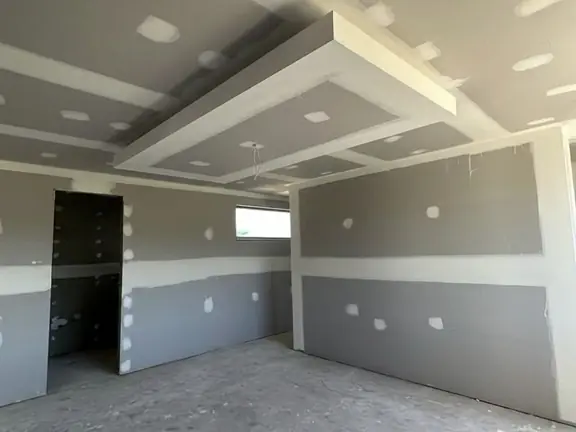
Kitchen bulkheads and joinery integration
The highest volume version of this job, in new builds and kitchen renovations across Sydney. The bulkhead closes the gap above the overhead cupboards so there is no dust shelf, hides the range hood ducting, and gives the cabinetry a built in look rather than a freestanding one. It is framed to the joinery, so it is sequenced with the cabinetmaker rather than around them.
- Face line set from the cabinet drawings and confirmed before framing
- Range hood ducting and cabling confirmed in place before sheeting
- Cornice or square set at the junction, whichever suits the kitchen
- Sequenced with the cabinetmaker so neither trade is waiting on the other
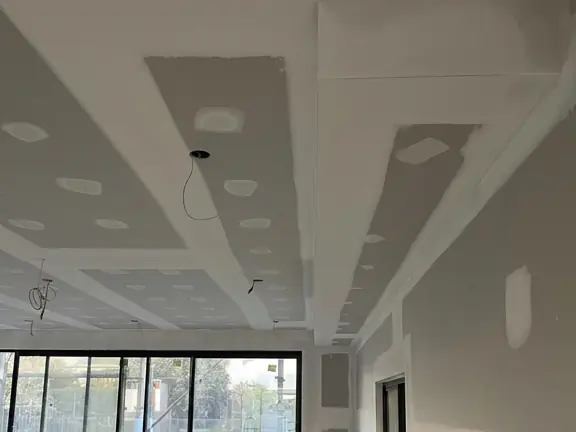
Curved bulkheads, coffers and LED shadowline details
The feature version: a curved transition in an entry or stairwell, a coffered ceiling over a dining table, or a shadowline detail carrying a concealed LED strip. These are the jobs where the finish level conversation happens at the quote rather than at handover, and where the framing does most of the work.
- Framing centres set to the radius so the curve reads as a curve
- Level 5 finish where a light source will wash the face
- Shadowline and coffer details set out with the electrician's fitting in hand
- Curved arch reveals and bay window heads in Federation and Victorian homes
What goes wrong with a bulkhead, and what stops it
A bulkhead is a small job with an unusual property: most of its faults cannot be fixed at the finishing stage. A wall that is slightly out gets floated flat with compound, but a bulkhead face that lands 20mm proud of the cupboards below it has to come apart. That is why the set out matters more here than the plastering does.
The face does not line up with the cabinetry below it
This is the one that hurts. A bulkhead face that sits proud of or behind the overhead cupboards reads as an error from every angle in the room, and unlike almost every other plastering defect it cannot be finished out. It has to be reframed. We set out from the joinery drawings rather than from the wall, and where the cabinetmaker has not finalised anything yet we would rather wait than guess a dimension.
Services not in before the bulkhead closes up
A bulkhead exists to hide things, so everything it is hiding has to be in place and tested before it is sheeted: the range hood ducting, the exhaust, the condensate line, the cabling for whatever lighting is going in. Closing up early means opening it again, and an opened bulkhead is never quite the same. We confirm what is going in with you before we sheet rather than after.
A curve with visible flats in it
Curved bulkheads are framed at close centres and lined with flexible board, and the framing spacing has to suit the radius. Too wide and the curve comes out as a series of short straight sections that catch the light. Cold matters too: flexible board is less flexible on a cold dry Sydney winter morning than it is in February, which is a documented property of the material rather than a knack. We frame to the radius and work the board in conditions it can take.
The LED strip goes on and the finish looks wrong
A light source washing down a bulkhead face is what the manufacturer's guidance calls a critical lighting condition, and it shows every joint and fastener that a normally lit surface hides. This is the most common bulkhead complaint and it is usually not a workmanship problem at all: it is a Level 4 finish being asked to perform in Level 5 conditions. We ask what lighting is going in before we quote, so the finish is specified for the light rather than discovered by it.
A crack along the line where the bulkhead meets the ceiling
The bulkhead and the ceiling it hangs off are different structures moving at slightly different rates, and where nothing is detailed at that junction it will eventually show as a hairline crack running the length of the room. It is preventable at framing stage and awkward afterwards. Every bulkhead to ceiling junction gets a control joint rather than being jointed rigid and hoped over.
A leaking condensate line inside the bulkhead
Air conditioning condensate drains are routinely run inside bulkheads, and when one lets go the water has nowhere to go except into the plasterboard it is enclosed by. The first sign is usually a stain rather than a drip. We are not the trade that installs them, but we will tell you where yours runs and where an access point makes sense, because a bulkhead with no way into it turns a small plumbing repair into a plastering job.
Three things that decide whether a bulkhead looks right
It is set out from your joinery, not from the wall
The single dimension that matters on a kitchen bulkhead is where its face lands relative to the cupboard doors underneath. Flush, proud by a deliberate reveal, or set back are all legitimate choices, and picking one by accident is not. We work from the cabinetmaker's drawings and confirm the face line with you before anything is framed, because this is the one part of the job that finishing cannot rescue.
If lighting is going in it, that changes the finish level
An LED strip washing down a face, or downlights set into the underside, create what the manufacturer's guidance calls critical lighting: silhouette and spot lighting are both named conditions. That is a Level 5 surface by the standard's own criteria, not a Level 4 one. It is the most common cause of a bulkhead argument and it is entirely avoidable, provided somebody asks about the lighting before the finish is quoted. We ask.
Curves have two different minimum radii, and the direction matters
Flexible plasterboard will take a tighter curve outward than inward. Installed vertically it bends to a 250mm radius convex, but only 450mm concave, so a design that works one way round may not work the other. Cold, dry weather reduces what the board will take, which is a real consideration on a Sydney winter morning. If you have a curve in mind we will tell you before we start whether it is achievable in board or whether the design needs to open up slightly.
Get a free quote
Send a photograph of the space and, if you have them, the kitchen or joinery drawings. Two things are worth telling us in the same message: what the bulkhead is hiding, and what lighting is going in or on it. The second one changes the finish, so it is better answered now than at handover. Quotes are free, and there is no travel charge to any suburb we work in.
Brands we supply and install
Plasterboard, cornice and compounds from the major Australian manufacturers, delivered to your job and included in the price.
Service available across every Sydney region
Central and Inner Sydney
Sydney CBD, Pyrmont, Surry Hills, Marrickville, Burwood, Strathfield and Sydney Olympic Park
The Eastern Suburbs
Bondi, Double Bay and Randwick
North Shore and Northern Sydney
North Sydney, Mosman, Manly, Lane Cove, Chatswood, Ku-ring-gai, Hornsby, Macquarie Park, Ryde and Castle Hill
Western Sydney
Parramatta, Blacktown, Merrylands, Fairfield, Liverpool, Bankstown and Penrith
South West and Macarthur
Austral, Leppington, Oran Park, Camden and Campbelltown
Southern Sydney and St George
Cronulla, Miranda, Sutherland and Hurstville
Frequently asked questions
Should I remove the bulkhead in my kitchen?
Find out what is in it before you decide. Plenty of bulkheads are purely cosmetic and can come out, but a great many are hiding a range hood duct, an air conditioning run, plumbing, or the underside of a beam, and none of those move cheaply. In an apartment there is often no roof space at all, which is exactly why the bulkhead exists. Send us a photograph and tell us what is above the kitchen and we will tell you honestly whether it is a candidate for removal.
What can I do with the bulkhead above my kitchen cupboards?
Three things usually. Leave it and have it finished flush and painted to match the ceiling, which makes it disappear. Reface it so it reads as part of the cabinetry rather than part of the ceiling. Or make a feature of it with a shadowline or an LED strip, which is the option that changes the finish level required. If your new cupboards are going to the ceiling and the old bulkhead is shallower than the new joinery, it usually needs extending rather than removing.
Can I build a kitchen bulkhead myself?
The framing is within reach of a confident DIYer. The two parts that catch people out are the set out and the finish. Getting the face to land exactly where it should relative to the cupboards is unforgiving, because it cannot be corrected with compound afterwards, and any bulkhead with lighting on it needs a standard of finish that is difficult to achieve by hand. If you are framing it yourself and want us to sheet and set it, that is a job we are happy to quote.
How much does a kitchen bulkhead cost?
It is priced as a job rather than by the metre, because a short run over a set of cupboards and a curved coffer over a dining table are not the same work. As a guide, a straight bulkhead of roughly three metres by one metre comes in around $500 for the gyprock lining, which means sheeting and setting a bulkhead that has already been framed. What moves it from there is the length, whether it is straight or curved, the finish level the lighting calls for, whether cornice or square set is going on it, and whether the framing has to be built as well rather than just lined. Send a photograph and the dimensions and we will turn that guide into a real figure.
Should my bulkhead have a cornice or be square set?
Both are legitimate and it is mostly about what the rest of the room does. Cornice is more forgiving, sits comfortably in a traditional kitchen, and is the cheaper of the two. Square set gives a crisp modern line and suits a flat contemporary kitchen, and it costs more because it is less tolerant of any movement in the frame and needs sheet ends fastened at closer centres. If the kitchen has square set elsewhere, matching it is worth the money.
Do I need a bulkhead if I want cupboards to the ceiling?
Often not, and that is a legitimate answer. Cabinets taken to the ceiling remove the dust shelf and the visual gap, which are two of the main reasons a bulkhead exists. What you cannot avoid is anything the bulkhead was concealing: if the range hood duct or an air conditioning run passes above that line, something has to box it in, and that is normally a shallower bulkhead rather than none at all.
Can I put LED strip lighting on or under a bulkhead?
Yes, and it looks excellent when the finish has been specified for it. Tell us before the quote rather than after, because a light source raking across a face shows every joint that ordinary lighting hides. That means a Level 5 finish on the faces the light touches, which is more work than a standard finish and needs to be in the price. It is the difference between a detail that looks intentional and one that looks like a bad plastering job.
Why is there a crack where my bulkhead meets the ceiling?
Because the two are separate structures that move at slightly different rates, and if that junction was jointed rigidly there was nowhere for the movement to go. It is one of the most common hairline cracks in Sydney homes and it is not a sign of anything structural. Repairing it properly means opening the junction and detailing it as a control joint rather than filling it again, which is why the same crack tends to come back on houses where it has just been painted over.
Ready to get started?
Get a fast, free quote, or call now and speak to someone who can help.