Renovation plastering and re-lining in Sydney
We re-line walls and ceilings in existing Sydney homes, form new walls where old ones come out, replace ceilings that have had enough, and tie all of it into whatever is staying. Renovation is the harder half of this trade, and not for the reason most people expect: the plastering is ordinary, but nobody knows what is behind the old lining until it comes off, and everything from the screw we use to the thickness of board we order depends on what is found there. We supply all the materials, work around you if you are still living in the house, and leave the walls sanded and ready for your painter. Supply and installation starts at $35 per square metre, and for most renovation work a few photographs are enough for us to price it.
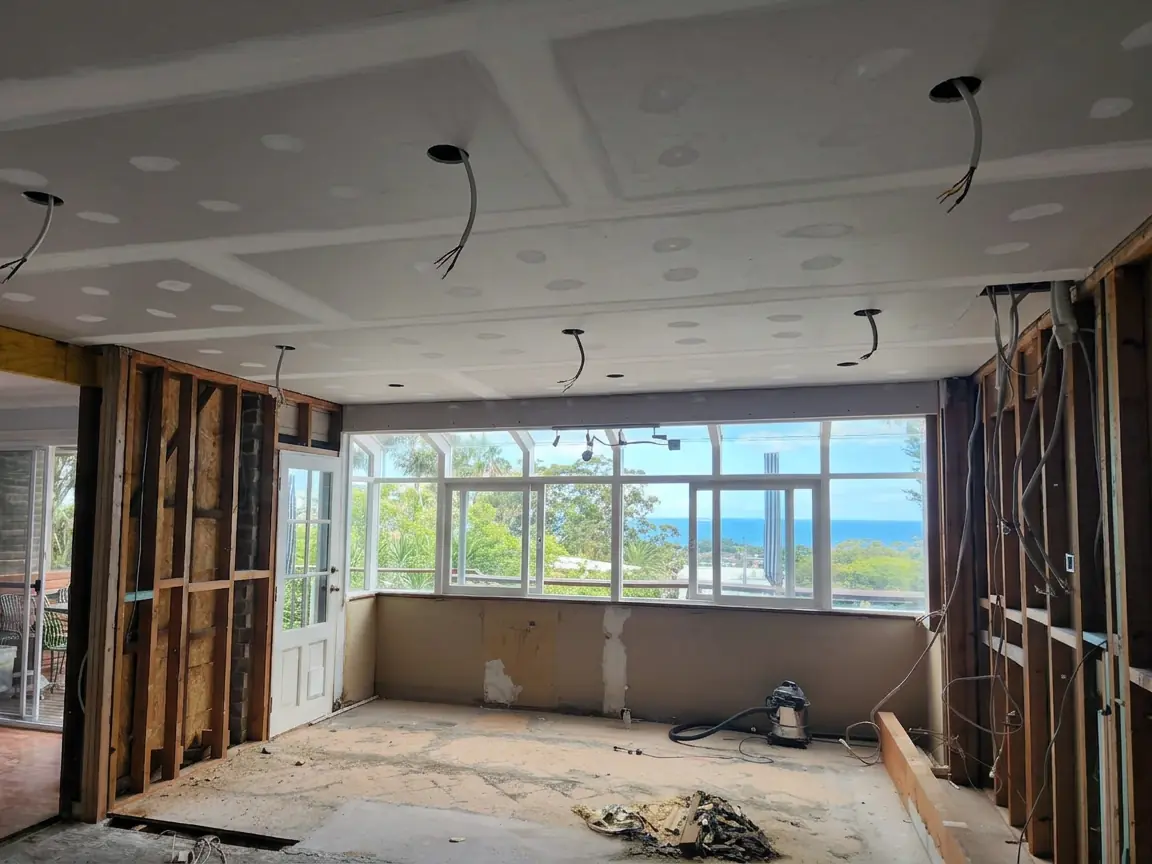
Renovating around people who still live there
Most Sydney renovations happen in a house somebody is still sleeping in, often a terrace with no side access, one staircase and no room to bring a full length sheet through the front door. That changes the method rather than just the schedule, and it is planned before anything is pulled off a wall.
- Dust containment and floor, stair and joinery protection set up before strip out begins
- Extraction on the tools rather than a clean up at the end
- Predictable daily start and finish times, and a clean down every day
- Sheet lengths chosen for the access you actually have, not the ideal
- Where a job is in a unit, building access and lift bookings planned into the programme
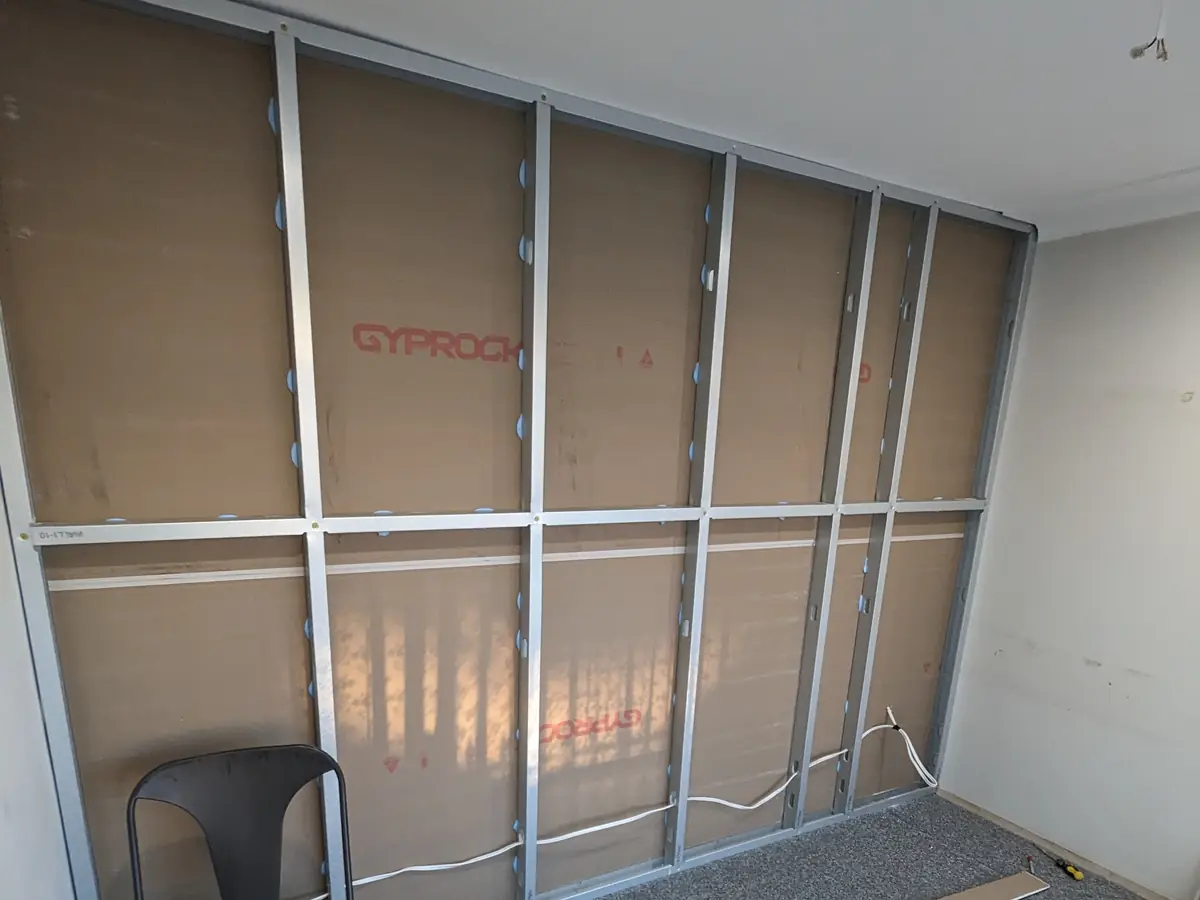
Wall removals, ceiling replacement and open plan conversions
Taking a wall out or replacing a whole ceiling turns a lining job into a framing job first. New partitions get framed off the existing floor, openings get trimmed, and the ceiling has to read as one continuous plane across what used to be two rooms, which is the part people notice.
- New partitions framed in timber or steel stud off the existing structure
- Ceilings replaced rather than patched where the original has failed
- Control joints designed into every junction between new and retained work
- Cornice matched to the existing profile, or a deliberate change to square set
- Back-blocking behind butt joints on the long open spans a knocked through room creates
What goes wrong on a renovation, and what stops it
Almost every unpleasant surprise on a renovation is something that was already there, hidden behind lining that nobody has looked behind in fifty years. None of it is avoidable by wishing, but all of it is cheaper to find early than late. Here is what turns up most often in Sydney homes, and how we keep each one from turning into a stopped job or a cracked wall.
Asbestos found once the lining comes off
Sydney's renovation stock spans four different lining technologies, and one of them is asbestos cement sheet. It cannot be identified by looking at it, by us or by anybody else, and a mid strip discovery stops the whole job while testing and licensed removal are arranged. We establish the age and renovation history of the house before quoting, and on anything from before the 1990s we would rather it was tested than guessed at. We do not remove asbestos and we do not work with fibro.
Live services hidden behind the old wall
Old wiring, gas lines and water pipes were run through walls in eras with different rules and no as built drawings. Cutting into an unknown wall blind is how a renovation becomes an electrician's emergency. We detect before we cut rather than after, and where something is found in the way it gets referred to the right trade instead of worked around.
A frame that is nowhere near straight
Century old hardwood has moved, and old framing is rarely at a spacing any current board is rated for. Sheeting straight onto it gives you a wall that reads wavy under any decent light. Every member gets checked against a straight edge and either planed back or packed out first, and where the spacing is wider than the board allows we add framing or move to thicker board. This preparation is usually the larger half of the labour, and it is also where termite damage and notched or undersized members get found.
Cracking along the line where new work meets old
New plasterboard tied rigidly into century old lath, fibrous plaster or masonry will crack along that junction within months, because the two materials move at different rates and the joint has nowhere to give. It is the single most common renovation complaint and it is entirely preventable. Every change of lining material is treated as a control joint rather than an ordinary butt joint, which is what the manufacturer's own guidance requires.
A cornice profile that is no longer made
Federation and inter war homes carry profiles that went out of production decades ago, so a repair using whatever is on the shelf leaves a visible mismatch in the same room. We check what is there before ordering anything, and where nothing current matches we will tell you the options honestly rather than fitting something close and hoping.
Damage to the floors and joinery you are keeping
Strip out generates rubble, dust and traffic through rooms nobody is renovating, and original floorboards, stair treads and joinery are the things that cannot be replaced. Protection and dust containment are set up before the first sheet comes off rather than swept up afterwards, and the extraction runs on the tools rather than a broom at the end of the day.
Three things that only come up on a renovation
We work out what your walls actually are before quoting
Sydney homes are lined in four different technologies depending on when they were built: lath and plaster in the oldest, fibrous plaster sheet through the middle of last century, asbestos cement sheet in the fibro era, and plasterboard from the 1970s onwards. Each behaves differently, comes off differently and ties into new work differently. A quote written without knowing which one is in front of it is a guess, and the variation lands on you.
Old hardwood takes a different screw, and most people use the wrong one
Older Sydney homes are framed in seasoned hardwood rather than the pine used on new builds, and the manufacturer puts hardwood in the same fastener class as light gauge steel: a needle point screw, not the coarse threaded screw that works all day in pine. The wrong one strips, snaps, or fails to pull the sheet up tight, and you find out months later when the fasteners start showing. It is a detail that simply does not exist on a new build.
What is staying sets what we order
If the board being retained is 13mm, new 10mm board beside it leaves a step that cannot be jointed out flat no matter how much compound goes over it. The same logic runs through the whole job: the existing level of finish, the cornice profile and the framing spacing all constrain what can be done rather than being chosen freely. An original 1920s ceiling was never a Level 4 surface, so matching it and matching a modern Level 4 are two different jobs, and it is worth deciding which one you actually want.
Get a free quote
Send a few photographs of the rooms and we can usually price renovation work from those without coming out, and there is no travel charge if a visit helps. Two things are worth telling us in the same message: roughly when the house was built, and whether you are living in it while the work happens. Both change the answer more than the square metres do. Quotes are free, and there is no travel charge to any suburb we work in.
Brands we supply and install
Plasterboard, cornice and compounds from the major Australian manufacturers, delivered to your job and included in the price.
Service available across every Sydney region
Central and Inner Sydney
Sydney CBD, Pyrmont, Surry Hills, Marrickville, Burwood, Strathfield and Sydney Olympic Park
The Eastern Suburbs
Bondi, Double Bay and Randwick
North Shore and Northern Sydney
North Sydney, Mosman, Manly, Lane Cove, Chatswood, Ku-ring-gai, Hornsby, Macquarie Park, Ryde and Castle Hill
Western Sydney
Parramatta, Blacktown, Merrylands, Fairfield, Liverpool, Bankstown and Penrith
South West and Macarthur
Austral, Leppington, Oran Park, Camden and Campbelltown
Southern Sydney and St George
Cronulla, Miranda, Sutherland and Hurstville
Frequently asked questions
Is it worth replacing plaster walls with plasterboard?
It depends on what the existing lining is doing. Sound lath and plaster or fibrous plaster that is flat and firmly attached is often better skimmed or repaired than torn off, and stripping it is a large and dusty job with no benefit. Where it has failed, where the ceiling is sagging, or where walls are coming out anyway, replacing it gives you a flat modern surface, an easier run for insulation and services, and a wall you can actually fix things to. We will tell you which situation you are in before you commit to the bigger job.
Can you put plasterboard over an existing plaster ceiling?
Sometimes, and it is worth asking rather than assuming. Overlaying avoids the mess of a strip out, but it only works if what is underneath is sound and firmly attached, because a new sheet screwed to a ceiling that is already letting go simply adds weight to a failing one. It also drops the ceiling height slightly and buries whatever is above it, including anything that should have been tested first. On a pre 1990 home we would want to know what the existing lining is before recommending it either way.
Can a plasterer replace a whole ceiling?
Yes, and in Federation and inter war Sydney homes it is one of the most common jobs we do. The old lining comes down, the ceiling framing is checked and brought back into plane, and new board goes up at a grade suited to the joist spacing that is actually there rather than the one it should have been. Where the room is a knocked through open plan space the butt joints get back-blocked, because a long span under raking light shows everything.
Why are lath and plaster walls no longer used?
Time and labour, mostly. A lath and plaster wall is built up in wet coats over timber laths by hand and takes days to complete and cure, where plasterboard is fixed, jointed and finished in a fraction of that. Plasterboard is also consistent in thickness, comes in tested systems for fire, acoustic and wet area performance, and can be manufactured to resist sag on a ceiling. The old walls were not worse, they were just slower than anybody could afford.
What are the disadvantages of plasterboard?
Three honest ones. It is less impact resistant than solid plaster, so a door handle or a kicked skirting can put a hole in it. It will not hold weight on its own, so a heavy mirror or a wall mounted television needs a fixing into the framing behind it or a backing installed while the wall is open. And it does not tolerate sustained water, which is why wet areas use a purpose made lining behind the waterproofing rather than standard board. If you are opening a wall up anyway, that is the moment to tell us where things are going to be hung.
What is the cheapest way to redo a ceiling?
Repairing what is there, where it can be repaired. A ceiling that is sound apart from cracked joints and a few loose spots is far cheaper to make good than to replace, and we will say so. What is not cheap is doing the small version twice: overlaying or patching a ceiling that is genuinely failing means paying for the work now and paying for the replacement later. We would rather look at photographs and tell you which one you have got.
Can I live in the house while the work is going on?
Usually yes, and most of our renovation work happens in occupied houses. The room being worked in is out of use and sealed off, and the noisy and dusty parts are the strip out and the sanding rather than the whole job. Each coat of jointing compound dries in under an hour, so we work through in sequence rather than leaving the house in pieces for days, and you do not need to be home while anything dries. The room you should expect to lose for a couple of days is the one we are in.
How much does renovation plastering cost in Sydney?
Supply and installation starts at $35 per square metre, and renovation sits above new build work for the same area because the frame preparation and the protection are the larger part of the labour. What moves it is how much of the old lining has to come off, how far out of plane the existing framing is, whether cornice has to be matched, and whether the house is occupied. Send photographs and rough room sizes and we will price it properly rather than quote a range.
Ready to get started?
Get a fast, free quote, or call now and speak to someone who can help.